Showing posts with label Eleutherodactylus campi. Show all posts

Texas Chirping Frogs - Revisited
Little chirpers in the genus Eleutherodactylus


Greenhouse Frog (Eleutherodactylus planirostris)
from Naples, Florida

OK, so I've made a comparison entry before for the "Texas" species in the genus Eleutherodactylus, the Rio Grande Chirping Frog (E. campi or E. cystignathoides, if you prefer 😜) and Cliff Chirping Frog (E. marnockii).  But there's a new chirper in town, the Greenhouse Frog (E. planirostris) and we need to figure out how to identify it as well.

The Greenhouse Frog is spreading through the state of Texas. It is most often transported as frogs or eggs in potted plants (thus the name "greenhouse").  It is originally from the Caribbean, but is well established in Florida and that is probably the source of their transport across the Gulf Coast and into Texas. In fact, this species has spread to China and Taiwan, Singapore, the Philippines, Guam, Hawaii and many places throughout Mexico and Central America.

The Rio Grande Chirping Frog is native to eastern Mexico and the tip of south Texas, but has also been spread north through transport of frogs and their eggs.  They have been expanding their range in Texas over the last 40+ years.   And their rate of spread can be quite quick.  I remember looking for herps in west Houston in the late 70s and early 80s.  I flipped a lot of trash but never saw these tiny frogs.  But when I went back to those same areas in the mid 1980s, Rio Grande Chirping Frogs were abundant in the exact same places.

The reason these small chirping frogs in the genus Eleutherodactylus have spread so quickly is that they are natural invaders.  Not only are they tiny and easy to move around, but they are quite comfortable living in forests, weedy brushy areas, suburban gardens or even potted plants.  

But their most powerful invasion trick may be the fact that they have direct development.  This means they have no aquatic tadpole stage and their eggs just hatch into tiny little froglets.  Therefore the females don't have to find a pond or stream to lay eggs, they can just bury them in the soil of the potted plant they live in.   So eggs and babies get transported easily, the new arrivals can breed in the buckets they were transported in,et voilà!, you have an introduced population of chirping frogs.  It is worth noting that they are not known to be parthenogenetic (like we see in Brahminy Blindsnakes), so they still require a male and female or fertile eggs to be transported to establish a new population.

Previously, these little invaders were pretty easy to ID based on the fact that most areas only had one species or the other.   So if you were in Florida, it was a Greenhouse Frog (E. planirostris).  If you were in Texas, it was a Rio Grande Chirper (E. campi).  But now these two invasives are starting to spread towards each other and overlap in range.  Suddenly, just finding a small "chirping frog" doesn't always allow you to name the species.

Telling these two introduced species apart visually can be tricky.  I should mention here that much of my attempt to explain how to distinguish these species is derived from my limited experience and a lot from Tom Lott's (2017) published explanations

In general, some Greenhouse Frogs look noticeably different than Rio Grande Chirpers, others do not.  Both species are small and variable in color.  They are usually some shade of brown or greenish brown with some darker brown/black marks or reticulations on their dorsum.   Some show yellowish or reddish patterns as well.

But the Greenhouse Frog seems the more variable.  Some Greenhouse Frogs are brown, some are greenish brown, some are reddish brown and some are brick red.  Like some other Caribbean Eleutherodactylus, Greenhouse Frogs also have a "striped morph" which has bold light stripes on the dorsolateral edge of the body.   Rio Grande Chirping Frogs don't seem to have this morph?  

Also notice the mid-dorsal line of tubercles seen in this photo.  That is often another clue you are dealing with a Greenhouse Frog. 

If your little chirping frog has stripes like this, it is probably a Greenhouse Frog.  Rio Grande Chirpers don't show this color pattern.   Photo of Greenhouse Frog by Eliot VanOtteren from this iNaturalist record and used under Creative Commons license conditions.

One oft-cited difference is the colored "triangle" on the top of the head between the eyes and nose in the Greenhouse Frog.  But the Rio Grande Chirper can often show this light triangle on the head, it is just not as pronounced or as contrasty as you see in Greenhouse Frogs.  When it occurs in Rio Grande Chirpers, it is usually not much different in color to the rest of the body, just a bit lighter.  In Greenhouse Frogs this triangle is noticeable different (usually much lighter) than the body color.  Again, this difference is subtle but consistent.

Although this Rio Grande Chirping Frog (Eleutherodactylus campi) has a light triangle on its head, the dark mask helps us tell it isn't a Greenhouse Frog.
Palmetto State Park, Texas

One factor that might help distinguish them in areas of overlap is the present of a presence of a darker "mask" along the edge of their head through the eye (along the canthal ridge).  The mask fades as you move down towards the mouth, so it almost looks like the top of the head is "shading" the side of the face.   Not all Rio Grande Chirpers show this as much as others, but it is not usually seen in Greenhouse Frogs.   Some Greenhouse Frogs show lots of dark spotting on the face and even a dark stripe, but this "shading" pattern is not usually seen.


The dark mask along the edge of this frog's head leads us to identify it as a Rio Grande Chirping Frog (E. campi)

Another character that is sometimes give to help with the ID is the nature of the dark bar between the eyes (at the posterior edge of the triangle).  In Greenhouse Frogs, this bar is usually quite thick and continuous.  In Rio Grade Chirpers, this "bar" is made of a series of dark spots and usually broken in places.

To my eye, Greenhouse Frogs are also more rugose generally.  While Rio Grande Chirpers can have small tubercle-like bumps on their bodies, their skin between those bumps is fairly smooth.  Greenhouse Frogs have more "warty" skin with many more tubercles uniformly across their back.  This is a really subtle difference and doesn't work all the time in differentiating them. 

Another character that can help is the presence of a dark chevron on the back between the forelimbs (on the frog's "shoulders").   This dark arrow points backwards and is seen on many Greenhouse Frogs, but not on Rio Grande Chirpers. 

Greenhouse Frogs seem to have a more narrow rostrum (more pointed nose) than Rio Grande Chirpers as well.

So, if you find a small Eleutherodactylus in its area of overlap that has no dark mask along the edge of its head and a prominent lighter triangle on its somewhat pointy head, it is likely to be a Greenhouse Frog.  Otherwise it might be a Rio Grande Chirper.....maybe? 

Here's a couple of good example frogs that look superficially similar: 

This photo by Peter May, used under Creative Commons License, shows the combination of charateristics which can be used to ID most Greenhouse Frogs.

 
This photo shows the combinations of characteristics which can be used to ID most Rio Grande Chirpers.

_________________________________________________ 

So they can be easy to tell apart, or not.

But of course, my blog is supposed to be about frog calls.  So do their calls sound different?

Well, yes and no.  Both species make a chirp and a trill call.

Here's a group of Rio Grande Chirping Frogs calling.  You can hear a series of their chirps and their trills


And here's a group of Greenhouse Frogs from the Everglades in Florida.


Notice how much more complex the call of the Greenhouse Frog is. It is usually a double or even triple chirp ("ch-dip" or "chi-chi-dip") whereas the chirp of the Rio Grande Chirping Frog is a single "chip".  In musical terms, the Greenhouse Frog plays one or two grace notes before most chips, the Rio Grande Chirper doesn't.

So while the Rio Grande Chirping Frog will make more than one chirp in a row, they are more spaced out. Take a look at this comparison spectrogram showing a Rio Grande Chirper followed by a Greenhouse Frog. The gaps between the double chirps are two to three times longer in the Rio Grande Chirper.  Also the gaps between the chirp groups are shorter in the Greenhouse Frog (they are more "talkative").   You can see that the Rio Grande Chirper gets 5 chirps out in about 3 seconds, the Greenhouse Frog gets 11 chirps out in the same amount of time (actually it is two Greenhouse Frogs talking back and forth). 


Here is the recording of that spectrogram.  In the first five seconds you hear the chirps of the Rio Grande Chirper followed by the quick eleven chirps of the pair of Greenhouse Frogs.

 So If you can learn to listen for the frequent double chirps of the Greenhouse Frogs in the areas where they overlap, you should be able to learn to hear the differences.  You can't always identify one from a single chirp, but when they are calling repeatedly, they give themselves away.  In a mixed chorus of both species, it would be hard once again.

____________________________________ 

I started this blog post comparison about 10 years ago and am just now getting around to finishing it.  This is obviously a complex comparison that I will have revisit in the future, but if I don't stop now, I might never finish. 😉 

________________
© Chris Harrison 2025 

Lott, Tom.  2017.  Distinguishing between the Greenhouse Frog (Eleutherodactylus planirostris) and the Rio Grande Chirping Frog (Eleutherodactylus cystignathoides) (Anura: Eleutherodactylidae).  Southwestern Center for Herpetological Research 7(4) pp. 69-75.  https://www.southwesternherp.com/wp-content/uploads/2023/03/2017-SWCHR-Bulletin-Vol-7-Issue-4.pdf

Rio Grande Chirping Frog
Eleutherodactylus (cystignathoides) campi


The tiny Rio Grande Chirping Frog* is native to southernmost Texas and then into Mexico.  However, they have been widely introduced into larger cities in Texas and other states.   Their chirping calls can be heard any warm night in my backyard in San Antonio, Texas.

 This species range is expanding rapidly in Texas.   When I lived on the west side of Houston in the late 1970s, I had never seen it.   By the early 1980s, it was abundant in my old neighborhood.    And the expansion is continuing through both frog movement and our increased discovery of the species.

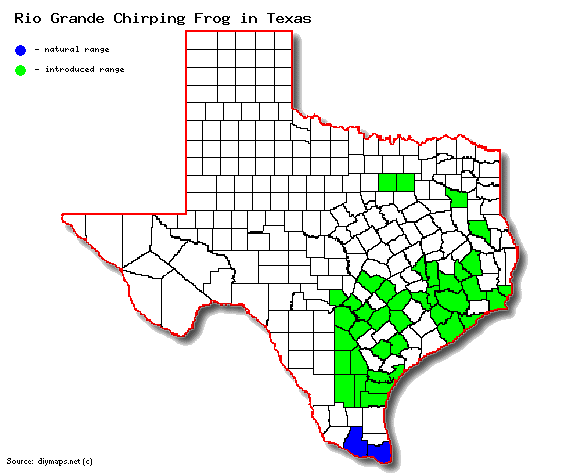
Here's a map I made in 2015 of the known records for the species in Texas:


 In January 2021, I made a new map based on the records available from above plus new records from iNaturalist.  You can see how many of the missing counties have been filled in plus how much further north it has been documented.   It's range into the hill country is difficult to identify due to confusion with the very similar Cliff Chirping Frog which occurs there.


The photo and recordings are from my backyard, although not necessarily of the 
same frog.
The most typical call is a short sharp chirp/cheep call.  The chirps are fast and each chirp increases in pitch.


Here's a closer view of the short call, showing how each "chirp" slides up in pitch.


These frogs also have a longer "trilled" call which they make.  It seems to me that the longer trill is the real call and the short peeps are just working up to it.


Here is the waveform and spectrograph for the first three seconds of this recording:


Here's a side by side comparison of the two types of call notes.  This comparison was created by cutting out some of the intervening notes in a long series of calls.


and here's the sonographic representation of that recording.


* It is worth adding that in 2020, a study elevated the Rio Grande Chirping Frog (Eleutherodactylus cystignathoides campi) to species status Eleutherodactylus campi.   The original E. cystignathoides is now restricted to the coastal plains of the gulf coast of Mexico.   We will have to see if that taxonomy is accepted.   This group still needs a lot more work.
_________________________________
© Chris Harrison 2012 and 2021


Carolina Wren vs. Rio Grande Chirping Frogs

Most frogs don't sound much like birds and most birds don't sound much like frogs.  However, you do come across a few calls that could potentially by confused.   

One such possible confusing pair is one I came across accidentally while recording bird calls in Palmetto State Park in Texas one winter day.   I happened to be recording the sounds of a foraging Carolina Wren (Thryothorus ludovicianus).  


As it foraged it made a short series of trills that sounded like this:


Even though I have recorded Carolina Wren calls before, this was the first time I had ever heard these short trills and I was immediately reminded of the trills of the Rio Grande Chirping Frog (Eleutherodactylus cystignathoides).


While the two calls are certainly not identical, they are superficially similar and since the wren is prone to give many variations of its various calls, it is worth stopping to consider which species you could be hearing.  And while wrens are diurnal and the Chirping Frogs call most often after dark, they will occasionally call after daytime rains.  And both can be heard calling from similar woodland habitat.   Probably not an error many people would make, more of a curiousity to someone like me who spends a lot of time listening!

__________________________________

© Chris Harrison 2016

The Central Texas Chirping Frogs
Eleutherodactylus cystignathoides vs Eleutherodactylus marnockii


Central Texas is now home to two species of Chirping Frogs in the genus Eleutherodactylus.   Historically, the hill country region of Central Texas was the haunt of the Cliff Chirping Frog (E. marnockii).  These frogs reside in the rocky hills and canyons of the Edwards Plateau and west into the mountains of West Texas.   They range south into Mexico but their range is poorly known due to confusion with a very similar species that occurs south of the border*.


Known distribution of the Cliff Chirping Frog in Texas

However, over the last 25-30 years, another species of Chirping Frog has been moving in to the area.  The Rio Grande Chirping Frog (E. cystignathoides, now E. campi) was formerly restricted to the southern tip of Texas in the Rio Grande Valley and south into Mexico.  But this small frog has a propensity for living in gardens and being transported around the state in potted plants.  They have now spread into many cities of Texas and into the rural areas between the cities.  When I was a teenager in Houston in the late 1970s, there were no Chirping Frogs in the Houston area.   By the middle 1980s, they were abundant.  They are continuing to spread and should eventually be documented in all the wooded counties of the eastern half of Texas.  They have spread east into Louisiana and undoubtedly will end up being recorded in OK and AR eventually.**


Native and Introduced distribution of the Rio Grande Chirping Frog in Texas

The gaps in the map for the Rio Grande Chirper in south and southeast Texas are probably due to them not being documented there rather than not being present.  This is a tiny little frog that is easy to overlook and its call is often dismissed as being from a bird or insect.


Here is a map showing the two species ranges together.  The blue counties are those where only Cliff Chirpers are documented, the yellow counties where only Rio Grande Chirpers have been documented and the green counties are counties where both have been documented (although they usually occur in different habitats).   The two red counties represent records for Cliff Chirping Frogs that are questionable based the availability of habitat.  Rio Grande Chirping Frogs occur in both of those counties.


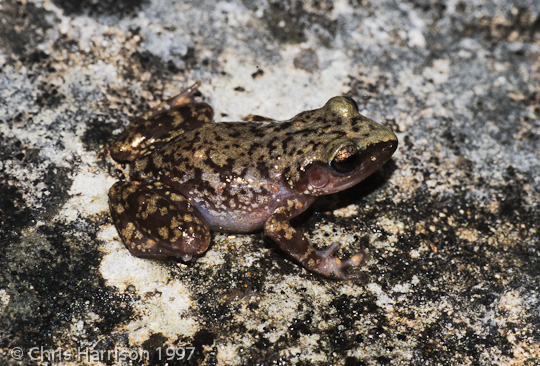
When seen as adults, these two species are reasonably easy to tell apart.  The Cliff Chirper is a noticeably larger frog with larger adults reaching the size of a quarter.  Their overall color pattern is a mottled brown/green on a darker background although they are highly variable.  Some are almost yellow in ground color, others can be very dark.  They usually have a darker line running along the snout to the eye.


Cliff Chirping Frog
Hays County, Texas
Cliff Chirping Frog
Crockett County, Texas


The Rio Grande Chirping Frog has a similar pattern and is again highly variable, but it is noticeably smaller as an adult.  An adult Rio Grande Chirper can sit on a dime and a huge adult would sit easily on a nickel.  Of course, a small Cliff Chirping Frog could be this size as well.


Rio Grande Chirping Frog
Bexar County, Texas

So if you see an adult, you can tell them apart.  But what about their calls?
Unfortunately, both species make a "chirping" call and a sort of "trill".  Here is a chorus of Rio Grande Chirping Frogs from Bastrop State Park.  You can hear both the high "chips" and the "trill" call in between.


Here is a recording of a Rio Grande Chirping Frog from Medina County, Texas - 


Here are a few chips and trills from the Cliff Chirping Frog from Real County, Texas - 


and another series of Cliff Chirpers from Kerr County, Texas -


The obvious difference between their calls is the frequency (pitch) of the calls of each frog.  Possibly because the Rio Grande Chirping Frog is much smaller, the calls of the Rio Grande Chirping Frog are noticeably higher in pitch than the Cliff Chirper.  Although the "trill" part of the call is lower pitched in both species, it is consistently lower in the Cliff Chirper than the Rio Grande Chirper.


Here is a recording of a series of chirps made first by the Rio Grande Chirping Frog and then a series by some Cliff Chirping Frogs.  Even though there is a tiny overlap in the call range, by listening to a series of calls you can distinguish them.  Only the highest of the Cliff Chirper calls approach the lowest frequencies of the Rio Grande Chirpers -


Here is a spectrogram of that recording.  The green line is approximately at 2700 Hz.  You can see that the Rio Grande Chirping Frog calls (the first series) are generally above that frequency while almost all of the Cliff Chirpers are below that frequency.


I recently (2026) came across a recording of both species calling together on the west side of Austin in this iNaturalist record.   You can hear the louder, lower pitched Cliff Chirper and the higher-pitched Rio Grande Chirper calling together.  The Rio Grande Chirper is a bit faint in this recording.


Both frogs also make a "trill" as part of their call and once again, the Cliff Chirping Frog's trill is noticeably lower in frequency (pitch) than that of the Rio Grande Chirper.   Here is a few seconds of the Rio Grande Chirper followed by a few seconds of the Cliff Chirping Frog.  The trills are a little tougher to tell apart so it is better to rely on the relative frequency of the "chirp" part of the calls.


Unlike most other Texas Frogs, these species do not breed in water.  The males call from terrestrial sites like cracks and crevices, from bushes or trees or just on the ground.   For this reason, people often don't recognize them as frogs since there may not be significant water nearby.  I have been contacted by people asking what species of bird is chirping in their backyards on moist summer nights.

After breeding the eggs are laid on land in a moist area.  The eggs hatch into full formed froglets rather than tadpoles as the whole tadpole stage is spent inside the egg.  Because they do not need open water for their tadpole stage, they easily adapt to living in suburban backyards, etc. and can be transported to new locations where they can set up and breed.  This is part of the reason for the success of the Rio Grande Chirping Frog in spreading across the eastern parts of Texas.


© Chris Harrison 2015


* Those looking in a field guide to US or Texas Amphibians might note there was another species formerly listed as occurring in far western parts of Trans-Pecos Texas called the Spotted Chirping Frog (E. guttilatus).  Recent research shows that E. guttilatus does not occur in the US and all west Texas Chirping Frogs are the same species, E. marnockii.


** To further complicate matters, there's a new frog in town as well!  The Greenhouse Frog (Eleutherodactylus planirostris) has now been documented in SE Texas near Galveston.  This species is almost identical to the Rio Grande Chirping Frog in size and pattern and their calls are very similar.  It might take some time to document the spread of this frog in SE Texas due to how difficult it is to tell it from the Rio Grande Chirper.