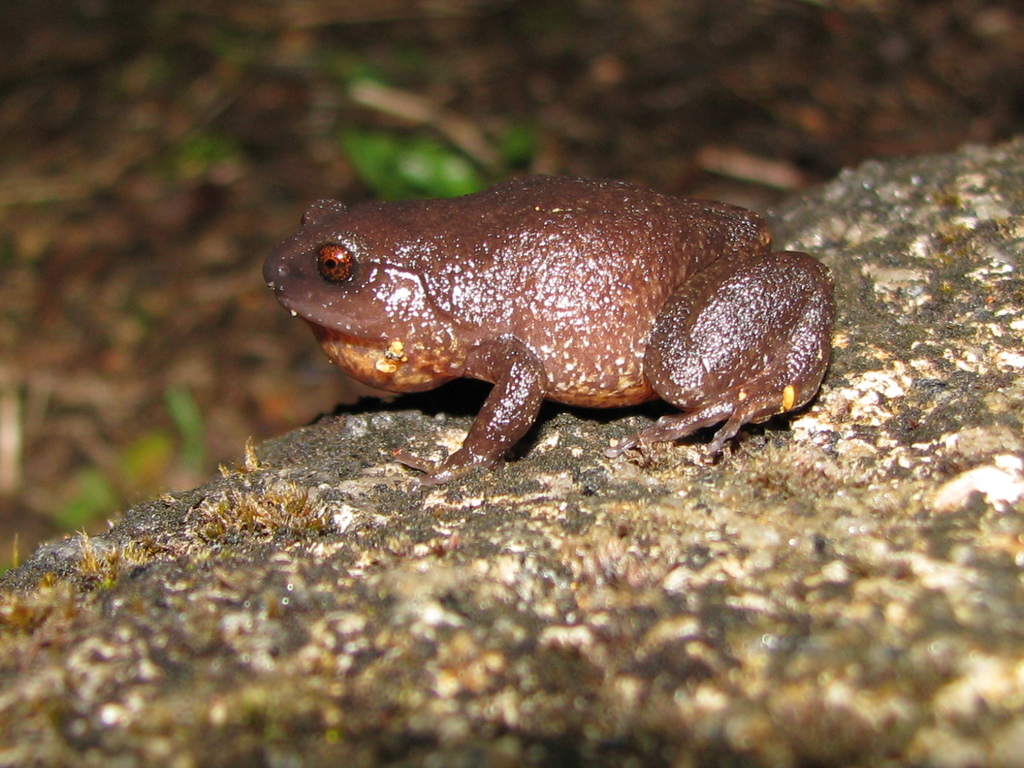
Gray Treefrog
Hyla versicolor
Bastrop County, Texas


This Gray Treefrog (Hyla versicolor) was calling from a small roadside tree after some heavy rains in April, 2015 in Bastrop County, Texas.  

Eastern Gray Treefrogs are physically indentical to the Cope's Gray Treefrog (Hyla chrysoscelis) but can be told by their calls.  This area of Bastrop County, Texas is right at the western boundary of the range of Hyla versicolor in Texas.  West of this area, you find Hyla chrysoscelis.  There are a few areas where the two species occur sympatrically.  

Unfortunately, their ranges are not well mapped out due to the fact that they can't be identified from museum specimens which are traditionally the primary source for creating field guide maps.  Many maps simply combine the ranges of the two species implying that they are sympatric over most of their range in Texas which is not the case.

The call of the Eastern Gray Treefrog is a pretty trill with a "bird-like" quality.  


When you look at the spectrogram for a single trill, you can see that it is a series of individual notes repeated rapidly in succession.


By counting the individual "notes" and dividing by the time it takes to make those notes, you can calculate that this frog gave 14 notes in approximately 0.6 seconds for a call rate of slightly over 23 notes per second.   Cope's Gray Treefrog has a much faster rattle, squeezing in well over 30 notes per second.  I have another post comparing the calls coming.

To the ear, the call of the Eastern Gray Treefrog is noticeably different that the dry rattling trill of the Cope's Gray Treefrog.  With some experience, you can learn to distinguish easily in the field.

© Chris Harrison 2015

Recording with Phones - 2015

I have always been of the mindset that the quality of the photo you get with a camera or the quality of the recording you get with a recorder is partially attributable to the quality of your equipment and partially attributable to the skills of the photographer/recorder. 

That said, I have long been skeptical the ability to get good frog call recordings with a cell phone. I see these posted all the time on websites such as iNaturalist and they are generally pretty poor recordings.


My own attempts in the past have shown my phones to be noisy and not very good at picking up the subtleties of some species. However, a few days back, I was out recording frogs in Atascosa County, Texas after some heavy rains and I thought I would revisit this test with my new cell phone (an LG G3). 


So I pulled up along a quiet road where some Texas Toads (Anaxyrus speciosus) and a Rio Grande Leopard Frog (Lithobates berlandieri) were calling. 


I simultaneously held my phone and my microphone out the window and recorded with both. The microphone was a Sennheiser K6/ME66 using phantom power being recorded by a Tascam DR680 recorder. This recording combo has proven to produce a very nice, high quality recordings in the past. 


The phone recording was made by holding my phone next to the microphone and recording using the Tascam PCM recorder app for Android.  I feel this is the best app I have tried for getting quality recordings with an Android device.**


What I ended up with was two recordings. They were both treated the same way in Audacity. I cut out the exact same section (time) of each recording and then reduced the low frequency noise with the equalizer and adjusted the gain to bring the peaks up to -6db. 


I then pasted the two recordings together one right after the other. Can you tell which one is which?


Here's the spectrogram of the recordings:


And the answer is..........


the phone is the first part, the Sennheiser/Tascam is the second.  I'm amazed at how good the phone recording is.  The Sennheiser/Tascam does have a better signal:noise ratio, but the phone holds its own pretty well.  You can see how the Sennheiser/Tascam picked up more detail in the trill of the Texas Toads.


Does that mean you can get good recordings with a phone?  Sure, if you use good technique.  

  1. Have a good phone and a good app.
  2. Get as close as you can to the calling frog or chorus.
  3. Block the wind from making noise on your phone.
  4. Hold the phone very still/carefully.  Better yet, set it down on a surface so your movements don't get picked up as noise.
I was pretty pleased with the results of my informal test.  I will certainly feel confident using my phone to grab a recording in the future when I don't have better gear with me.

**I have recently begun using a new app on my smartphone for recordings called RecForgeII.  It is also free and seems to give you a bit more control than the (very good) Tascam PCM Recorder.

There is a very good, up-to-date discussion about using smart phones for recording wildlife (birds) on the Cornell Lab of Ornithology's Macaulay Library page. It is a great resource to read about how to use your phone to make quality recordings. 
__________________
© Chris Harrison 2016

Spotted Chorus Frog
Pseudacris clarkii


I happened to be driving near where I live in west San Antonio, Texas after some rain and heard a few of my favorite little spotted frog - the Spotted Chorus Frog (Pseudacris clarkii).  They were surprisingly cooperative.


I have lots of recordings of P. clarkii, and I normally wouldn't bother with another recording, but they were so cooperative that I couldn't resist pointing my microphone at them.

I also wanted the chance to document them here in western Bexar County, TX.   They are known from Bexar County, but not from the next county west (Medina County).  I was only a mile from the county line, so I drove west onto some other similar looking areas hoping to document them in Medina County, but couldn't find any on the other side of the county line.  Oh well a project for later!
___________________________________
© Chris Harrison 2015

Crawfish Frog
Lithobates areolatus


The Crawfish Frog (Lithobates areolatus) is a seldom seen frog of the prairies and open woodlands from eastern Texas and north up into SE Kansas then across to the Mississippi valley down to the gulf coast.

Although it has an apparently large geographic range, it has a somewhat spotty distribution which may be due do the difficulty if finding this frog.  Even in its range, it is a species of frog that most people are unfamiliar with.  This is likely due to the fact that it spends most of its time underground in burrows.  It often uses crawfish burrows and eats crawfish (along with anything else it can swallow).  This is where the species gets its common name.  It apparently only comes to the surface after heavy rains flood its burrows bringing it to the up to chorus and breed.

These frogs we calling from a flooded patch of prairie/pasture close to the Attwater's Prairie Chicken National Wildlife Refuge in Colorado County, Texas.  It was mild March evening and it had rained heavily in the preceding two days producing flooding patches among the remnant prairie grasslands of this region.

Although I heard many dozens of these frogs calling on this particular night, I had been exploring this area for several decades, both day and night, winter and summer.  Yet I had never encountered them before because I hadn't been there on the right night at the right time.

The call of the Crawfish Frog is loud and and easily heard over short distances. 
The call is usually described as a "snore" which is a fairly apt description. 

Crawfish Frogs - Colorado County, Texas

Interestingly, when you look at the spectrograph of their calls, you see that there is a descending higher pitched part to the call as well as the upward slurred snore.


You normally have trouble hearing the downward "whistle" over the loud snore, but I have edited out a selection of three calls here where the individual frog was further away and the whistle stands out more.  
Staying with the "snoring" motif, the whistle sounds like the exaggerated whistled exhale that some snorers produce between snores, although in this case it is simultaneous with the snore.


© Chris Harrison 2015

Strecker's Chorus Frog - finally!
Pseudacris streckeri

I had never really thought much about Strecker's Chorus Frogs (Pseudacris streckeri) when I lived in College Station, Texas during the early to mid 1980s.  Frankly, at that time I had little interest in frogs and toads in general and was more interested in snakes than any other herps.  My only real exposure to the existence of the species was seeing preserved specimens that I had to learn to identify for my herpetology course at Texas A&M.
After I returned to College Station after finishing my Master's degree, I was contacted by two individuals who needed Strecker's Chorus Frogs for their museum collections and asked if I could capture them a few specimens.  So I made a note to start looking for them while I was out and about in the area.  That was sometime in 1992.   Twenty-three years later, I finally found one!
I have several other blog entries on here about previous failures.  I had heard them on multiple occasions in both Texas and Arkansas but had never laid eyes on one of the little buggers.  But finally, on March 9, 2015, I was able to find some Pseudacris streckeri calling where I could actually see one.

And here is that frog:


I got a few other photos of individuals calling in the flooded grassy roadside ditch that night.  I didn't bother catching any for posed "field guide" type shots.  That may be a decision I may regret since it took me so long to find my first individuals!
The odd thing was they weren't that inconspicuous.  On previous occasions (notably this night in Arkansas) I had been near larger numbers of individuals all around me, but never sighted one.  Part of the problem in the past was that I had to wade into the water to find them and the vibrations/waves of me walking in the water may have been making them dive for cover.  On this night in DeWitt County, I was able to see them while standing on the muddy edge of the flooded ditch without disturbing the water surface.

Here is how most of them were found, floating in the water clutching grass clumps.


One individual let me get a bit closer before my disturbance of the water washed him off his grassy perch.


Here is an individual from the night in question -


And a recording of a chorus from the same area -


And here is a brief video of a couple of these little songsters singing.  There is a bit of wind noise in the second part and some Hurter's Spadefoot Toads (Scaphiophus hurterii) in the background  -


__________________________

© Chris Harrison 2015


Dainty Green Treefrog
Chlorohyla gracilenta


The Dainty Green Treefrog (Chlorohyla gracilenta) is a small treefrog of northeastern tropical Queensland.  They appear to occur within a variety of habitats in their range.  I have found them and heard them calling in rainforest, sugar cane fields, and flooded ditches in industrial parks.

Although it is a pretty little frog, its call is surprisingly harsh.  It is a long buzzy, nasal "raaagh" that ascends slightly in pitch before leveling off.


Dainty Green Treefrog call

___________________
© Chris Harrison 2015

This species was moved from the genus Ranoidea (and Litoria) into the genus Chlorohyla in 2025.  I am trying to update all of my blog entries. 

Australian Rocket Frog
Litoria nasuta


The Australian Rocket Frog (Litoria nasuta) is a medium-sized frog of the coastal strip of northern and eastern Australia.  I found it to be quite abundant in the areas of NE Queensland where I was recording.  I found them in natural grassy swamps, flooded sugar cane fields, flooded roadside ditches in rainforests and dry forests, and even flooded areas in the middle of towns.


Although many species of Australian Litoria are similar to treefrogs, many other species of Litoria look like true frogs of the family Ranidae.  The name rocket frog apparently derives from the fact that these frogs hop large distances very quickly "rocketing" away from predators.

The call of Litoria nasuta has two distinctly different sounds.  One sound is a sharp "pock, pock" sound that usually seems to be a warm up to the rest of the call.  Here is a group of Litoria nasuta giving their pock, pock calls in the Daintree National Park in Queensland.


Eventually, the move into more typical part of their call which can be described as a rapid, short, nasal "quacking" call.  To me it is somewhat remniscent of the call of the American Squirrel Treefrog (Hyla squirella).

Here is the nasal "quacking" part of their call - 


Here is an individual giving both calls sequentially from grassland pool edge near the Mareebra Wetlands Environmental Park.  First it gives the "quacking" call followed by the "pock" calls.  It was this individual that first taught me that both the frog species I was hearing were, in fact, the same species.  I was watching this individual as he switched songs, much to my surprise!


Litoria nasuta calls

Here is a recording of a large chorus of Rocket Frogs calling from the flooded edge of a sugar cane field near Miallo, Queensland.   You can hear both calls in this chorus.


© Chris Harrison 2015

Australian Green Treefrog
Ranoidea caerulea

The Australian Green Treefrog (Pelodryas caerulea) is a large treefrog that is widespread across the northeastern half of Australia, into New Guinea and the northern parts of the Solomon Islands.  

This species is often kept in captivity in other parts of the world where it is known by many names, including the "Dumpy" Treefrog in reference to its unusual appearance.


\

As can be seen in these photos, the intensity of the green coloration can vary.  The calling individual seen below was quite brownish green as contrasted with the bright green individual above.


These are large treefrogs and have a correspondingly loud call.  The call can be described as a loud "rork, rork, rork" that is repeated over and over at a rate of  2-3 calls per second.  

Here is an individual calling from some roadside bushes in Daintree National Park, Queensland, Australia.

Pelodryas caerulea call

________________  

© Chris Harrison 2015

Daintree Whistling Frog
Austrochaperina fryi

photo by Richard D. Reams.  Used by CC by NC license granted on iNaturalist.org


The Daintree Whistling Frog (Austrochaperina fryi) is a small microhylid restricted to the Queensland coast of of Australia within the Daintree National Park and nearby tropical rainforests.   

Daintree Whistling Frog Range Map
used under Creative Commons License granted by the Australian Frog Atlas

While I have heard this species calling on a couple of occasions, I was never lucky enough to see one.   So I have "borrowed" a photo under the terms of the Creative Commons license granted by Richard D. Reams for his iNaturalist record of this species (https://www.inaturalist.org/observations/86443392).

It is a very small frog with a very distinct loud call.  It is sometimes known as the Peeping Whistling Frog which is a pretty good description of its call.  The call is series of 5-25 high pitched whistled peeps.  Each series of peeps lasts for 2-3 seconds.  The main frequency of the peeps is between 3kHz and 4kHz and each "peep" actually increases in frequency during each call, although that isn't audible unless you slow the call down quite a bit.

The call is quite loud for such a small frog and carries well in the rainforest.

Here is a spectrogram of the call of this species -


Unfortunately, I never was able to see this species while in Queensland although I heard them calling on a number of occasions.

Here is an individual calling from the Daintree Rainforest near the Jindalba Boardwalk on wet evening in January 2015.

If you would like to download this recording, it is available on my iNaturalist record

© Chris Harrison 2015

Australian Marbled Frog
Limnodynastes convexiusculus


The Marbled Frog (Limnodynastes convexiusculus) is a medium-small sized Myobatrachid frog from northern and northeastern Australia north into New Guinea.  This frog is fairly common in NE Australia in grassland and open woodland areas and even in flooded areas of sugar cane fields.  I saw quite a few of them on roads at night.


This Marbled Frog seen below was recorded calling from a small pond next to the road near Lake Mitchell in Queensland.  There were two of them calling here and I walked around the pond several times looking carefully and simply couldn't find them.  Eventually, I figured out exactly where the sound must be coming from and carefully dug down through the vegetation until I finally exposed this frog that had been calling from buried deep under some vegetation.  No wonder he was so tough to find!

Here he is after being "unearthed".


The call of the Marbled Frog is a hollow metallic "ponk" sound.  Here is the call of the two from the pond above, including the one in the photo before he was uncovered.   


The following two Marbled Frogs were recorded from a flooded edge of a sugar cane field near Daintree, Queensland.  (The nasal "waaagh" you hear with them is Litora gracilenta). 

Limnodynastes convexiusculus calls from Daintree, QLD

© Chris Harrison 2014